Very sad news. Jim Ferguson was a brilliant scholar, a leading light in Anthropology, development studies and the social sciences and an allround amazing intellectual. He profoundly influenced my thinking and that of countless others.
I remember vividly reading his famous book ‘The Anti-Politics Machine’. I was in Lesotho doing fieldwork for my PhD and had a copy of the book with me. It was one of the absolute ‘must-reads’ in my field of development studies, and I knew I couldn’t be working in Lesotho and not having read it. It was an incredible experience: both the book itself, the way that Jim built his argument and the erudite way in which he combined astute ethnography and theoretical insights, as well as being in the context the book dealt with – the beautiful country of Lesotho.
It instantly changed my thinking. Given that I also studied a world bank intervention, the parallels between Ferguson’s book and my research were evident. But there were also important differences, and it took me time to work through them, empirically and theoretically. It ultimately led to a paper on ‘anti-politics as political strategy’ (https://lnkd.in/e4wdNrtg) that was a real turning point for me professionally, which would simply never have been possible without Ferguson’s work.
Later works, especially his books ‘expectations of modernity’, and ‘global shadows’ were equally influential. Global Shadows: Africa in the Neoliberal world Order, showed Anthropologists – and many others – that through ethnographical sensibilities, one can say something about bigger categories, including ‘Africa’ in the world order. Indeed, Jim urged as to do so, so as not to leave macro analyses to economists. As a political scientist-turned anthropologist/geographer, this resonated with me tremendously.
I was also very lucky to have interacted with him several times when he was visiting professor at Anthropology VU Amsterdam, where I did my PhD. Indeed, he even joined my PhD committee, which gave me a tremendous boost. We differed on several issues, especially in relation to the influence and structural force of capitalism, but debating Jim was always an incredible honour and pleasure. I always felt I was in the room with a ‘bigger’ person: never arrogant or domineering, but someone who simply thinks on some higher level I wanted to aspire to. Thomas Hansen’s description of Jim is spot on: “He wore his erudition and brilliance lightly”.
Jim Ferguson will be sorely missed. I am truly saddened by his passing, but also grateful for his work and incredible legacy. In the maddening times we are in, it is more important than ever to remember people like Jim Ferguson and the personal and intellectual example he set.
Posted in Uncategorized | 1 Comment »
Mongabay commentary by Robert Fletcher and me on the conservation implications of the re-election of Trump as president of the USA.
We wrote about the consequences of Trump becoming president the first time in our 2020 book The Conservation Revolution (Verso Books). There, we argued that, like the climate, biodiversity is very “likely to suffer under a Trump presidency” but that “this is not the only reason why his election is significant for conservation.” We argued that there is a much bigger challenge facing conservation, and we referred to this as the ‘Trump moment in conservation’:
“Basically, the Trump moment means that mainstream conservation refuses – at its own peril and that of the biodiversity it aims to conserve – to properly acknowledge the root causes of biodiversity loss and to support the radical types of responses necessary to halt and reverse this trend. Instead, […], many conservationists are content – often proudly or ‘pragmatically’ so – to join forces with the economic logics and institutions of destruction behind such terms as ‘natural capital’ or ‘ecosystem services.’ In doing so, they might occasionally slow down some biodiversity loss in some places. But at the very same time they strengthen the broader drivers of biodiversity destruction that completely undermine the small gains that might be made. This is the conservation equivalent of the ‘Trump moment,’ which can only be tackled by taking and supporting much more radical action.”
In the commentary, we urgently repeat our earlier plea: this second ‘Trump moment in conservation’ must be a wake-up call. Conservation must stop hiding behind its objective science, its pragmatic politics and its feel-good appeal to reorganize as a counter-hegemonic force in alliance with other movements around the world (climate justice, land back, Fridays for the Future and many more) that seek genuine system change.
We need a radical CONVIVIAL CONSERVATION movement, now more than ever. And we call upon the conservation sector to adopt, embrace and help build this.
Posted in Uncategorized | Tagged biodiversity, climate change, conservation, environment, nature | Leave a Comment »
22 September 2024
Since late August, I have been in the USA on a short one-month (left-over) sabbatical from @SDC @WUR to do a big research trip: traveling across the entire continental USA. Starting in Washington D.C., my colleague Jim Igoe from the University of Virginia and I have traveled the full length of the Lewis and Clark heritage trail all the way to Washington state, where we are now. Nearing the end of the journey, I wanted to write down some initial reflections, although it’s going to take a while to let it all sink in.
The goal of the trip was to gain a deeper understanding of the historical development of the westward colonial settlement of the USA, how this relates to biodiversity conservation, and how this has, over time, resulted in highly uneven forms of geographical development. While an enormous undertaking, the Lewis and Clark (L&C) trail provided an excellent entry-point. Meriwether Lewis and William Clark were the two army captains sent by President Thomas Jefferson on a journey of ‘discovery’ that took place between 1803 and 1806. This journey plays a major role in the American historical imagination, and along the entire length of the trail are many (!) historical sites, monuments, interpretive centres, statues and info boards that provide details on the L&C journey, their relations to native Americans and the natural environments they traveled through. By paying close attention to these, having conversations with people in these sites, and relating all this information to current socio-geographical patterns and issues, including especially native American reservations, protected areas and other conservation sites and actors, the trip has more than lived up to my (rather high) expectations. Some first reflections and insights:
- By following the L&C trail, we followed several major rivers, including the Ohio, the Mississippi and the Missouri, for very long stretches. This was completely logical back in L&C’s days, but much less so later on, of course, with the advent, first, of the railroads, second, of cars, highways and the Interstate system, and third, air traffic. Going overland following the rivers gave me a deeper appreciation of geographical patterns that ranged from the boundaries of (current) states, shifting boundaries between settlers and native Americans and the painful and unimaginable violence done to the latter, and the historical importance of the north-south continental divide. While many (myself including) often think of the east-west divide in the US, the early origins of European colonial settlements were equally influenced by the north-south continental divide. We crossed the north-south (Laurentian) continental divide around the border between South and North Dakoto, above which rivers flows to the Hudson Bay. This was a major route into what are now the northern states of the US for the fur trade, which were already quite well known by many trappers before L&C passed these areas;
- The dominant historiography of L&C along the trail is one of adventure, exploration and discovery, with tremendous emphasis on the heroism of the ‘corps of discovery’ that L&C led. The amount of people currently involved in curating the trail and all the information around it – (amateur) historians, enthusiasts, citizens, the National Parks Service, etc – is incredible. I knew that a lot was written about L&C, but the sheer amount of information, including the work done on (re)creating elements, tools and symbols of the journey (including the ships they traveled on!), is something far beyond what I imagined. This ‘iconization’ of L&C and their journey certainly plays a major importance in the historiography of the US and was given a particular boost around the bicentenary in 2003-2006, when a large group of people re-enacted the entire journey along the lines of how L&C must have done it.
- In this historiography, the role of native peoples is, at best, highly contradictory. While a lot of attention goes towards the ‘Indian’ tribes that L&C met, the narration of their roles is often done firmly within the context of the heroism of L&C’s journey, as the start of the ‘manifest destiny’ of the USA becoming a nation from Atlantic to Pacific (something that was anything but preordained at the time). By visiting several reservations, including Lake Traverse/Sisseton, Standing Rock, Fort Peck and Nez Perce and talking to people there, this iconized historiography is swiftly turned upside down and (actively) marginalized histories come to the fore. While in general it is quite easy to find a wealth of information by indigenous and native scholars and peoples on both L&C and general US history, along the trail we often had to actively search for this and several times leave the ‘official’ trail to find it;
- There is a lot of attention for the natural history work that L&C did and how their descriptions of plants and animals allow us to compare biodiversity patterns then and now. Reading these descriptions while traveling alongside the trail is often quite shocking, especially when comparing it to the major areas of extraction in North Dakota and Montana or the many areas along the Ohio river focused on fossil, sand and other material extraction, transportation and the many nuclear energy plants.
Much more to say, but I first need to properly analyze my data and then see where I want to take it. First, however, we need to get to the Pacific Ocean to finish the trip, after which we will travel to Toronto for some presentations and discussions at/with colleagues at University of Toronto. York University and University of Guelph!
Posted in Uncategorized | 2 Comments »
A major biodiversity conference, recently concluded in Montreal, Canada, was billed as the event that will decide the “fate of the entire living world”. All well then that the meeting closed with what has been hailed as a “historic” breakthrough: a deal to protect 30% of all land and water on Earth by 2030.
How historic is this deal, really? Judging from the effect of protected areas and major environment meetings over the last few decades, we should not get our hopes up. In fact, this deal may force us to reconsider the usefulness of such meetings altogether.
Read the opinion piece written with Prof. Rosaleen Duffy here:

Posted in Uncategorized | Leave a Comment »
New opinion piece with Han Wiskerke
Nederlandse boeren hebben keihard gewerkt om zich in een aantoonbaar onduurzaam landbouwsysteem overeind te houden. Dit zichzelf ondermijnend succes is nu zichtbaar aan zijn einde. Boeren moeten perspectief krijgen om naar een duurzaam systeem om te schakelen. En wetenschap en politiek moeten hieruit lessen trekken voor de nog veel grotere maatschappelijke omwenteling die ons te wachten staat. De stikstofcrisis is het spreekwoordelijke topje van de ijsberg van wat ons allen te wachten staat.
Posted in Uncategorized | Leave a Comment »

The German translation of the Conservation Revolution (Die Naturschutzrevolution) has been published by Passagen Verlag in October 2022! Order your copy here.
Prof. Reinhard Loske wrote a generous review of the book: Das Ende des alten Naturschutzes and a longer version here: Das Ende des harmlosen Naturschutzes.
Posted in Uncategorized | Leave a Comment »
I am delighted that the special section on political ecologies of extinction was published in the Journal of Political Ecology, Volume 28. Issue 1. 2021. Download the entire SI in one PDF file here:
CONTENTS:
Political ecologies of extinction: from endpoint to inflection-point. Introduction to the Special Section 696-704
Bram Büscher
The biopolitics of private conservation: jeopardizing labor and rhino to optimize capital? 705-720
Lerato Thakholi
Extinction in transition: coca, coal, and the production of enmity in Colombia’s post-peace accords environment 721-740
Hannah Meszaros Martin and Oscar Pedraza
Biodiversity Economy and conservation territorialization: a pyrrhic strategy in Kwazulu-Natal 741-759
Adrian Nel
Between overstocking and extinction: conservation and the intensification of uneven wildlife geographies in Africa 760-781
Bram Büscher
Ice and Ivory: the cryopolitics of mammoth de-extinction 782-803
Charlotte A. Wrigley
Enjoying extinction: philanthrocapitalism, jouissance, and ‘excessive environmentourism’ in the South African rhino poaching crisis 804-822
Stasja Koot
Populist authoritarian neoliberalism in Brazil: making sense of Bolsonaro’s anti-environment agenda 823-844
Sierra Deutsch
Monitoring extinction: defaunation, technology and the biopolitics of conservation in the Atlantic Forest, Brazil 845-863
Thomas Kiggell
Crisis conservation and green extraction: biodiversity offsets as spaces of double exception 864-888
Philippe Le Billon
Posted in Uncategorized | Leave a Comment »
In December 2021, I did an interview with the great Evgeny Morozov of the Crypto Syllabus on Nature3: https://the-crypto-syllabus.com/bram-buscher-on-nature3/
As Egeny writes: “Do crypto technologies offer a radical new way to fix the problems related to climate change and other forms of environmental destruction? Or are they just another set of “non-transformative” solutions that feed off technological optimism and solutionism? Making sense of claims advanced by climate-focused projects in the crypto space could be difficult: while many of them do sound well-intentioned and benign, they are also keen to invent new (and often bombastic) terms to describe practices for which older, already discredited terms do exist.”
My core argument: “Though they talk about tokens, blockchains, and NFTs, crypto projects that aim at conservation still rely on monetizing biodiversity and trading its ‘services’ and basically seem to render more complicated what was not working in the first place”.

Posted in Uncategorized | Leave a Comment »
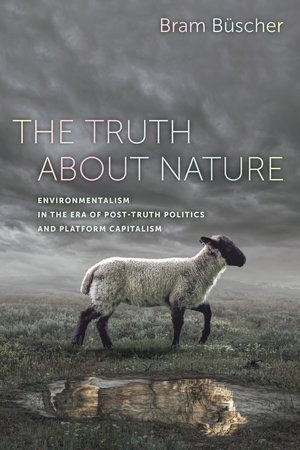
By Bram Büscher, author of The Truth about Nature: Environmentalism in the Era of Post-Truth Politics and Platform Capitalism
Environmental organizations have become fully dependent on social media platforms. This is not just getting in the way of meaningfully tackling the climate and biodiversity crises. It will make them worse and more complicated. It is time for environmentalists to rethink digital media and start organizing counterpower.
Read the entire blog on: https://www.ucpress.edu/blog/55422/why-tackling-environmental-crises-requires-challenging-big-tech-power/
Posted in Uncategorized | Leave a Comment »
Available as from today, 15 December 2020, around the world!
Get your copy via The University of California Press website, or any other bookshop!

Posted in Uncategorized | Leave a Comment »
-
New posts!
- RIP James Ferguson: a tribute
- Will ‘Trump Part II’ be the wake up call needed toward more effective conservation?
- Following the Lewis and Clark heritage trail across the USA to better understand the links between settler colonialism, biodiversity conservation and the geography of capitalism
- Biodiversity treaty: UN deal fails to address the root causes of nature’s destruction
- Stikstofcrisis iets van boeren? Slechts een teken van wat ons allen te wachten staat
Twitter feed
Tweets by brambuscher-
Join 172 other subscribers
Archives

 Bram Büscher